



Life Cycle
Perennial

Plant Characteristics
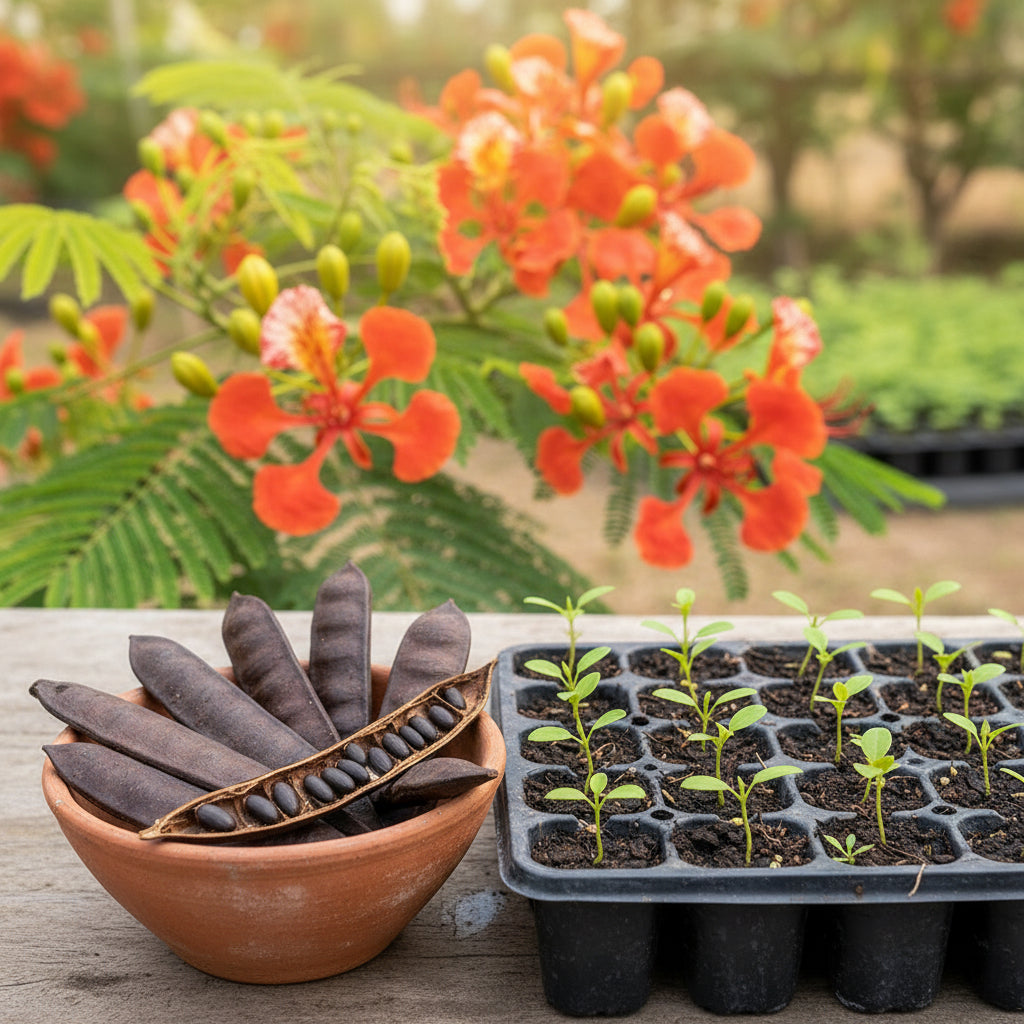
Fiery red flowers

Growth Habit
Tree form

Bloom Season
Summer

Flavour Profile
Ornamental landscaping

Suitable for
Outdoor

Planting Season
Spring

Fruit Size
N/A

Plant Height
8–12 meters

Light Requirement
Full Sun

Water Needs
Moderate

Hardiness Zones
USDA Zones 10–12

Container Garden
No

Plant Spacing
6–8 meters

Planting Depth
1–2 cm

Growing Conditions
Warm climate
Frequently Asked Questions
Can Flamboyant Flame Tree produce a spectacular canopy of red flowers?
Can Flamboyant Flame Tree produce a spectacular canopy of red flowers?
Yes. As it matures, the tree is admired for its brilliant scarlet-red flower clusters that create a dramatic seasonal display.
Does the fern-like foliage provide ornamental interest year-round?
Does the fern-like foliage provide ornamental interest year-round?
Yes. The finely divided, feathery leaves give the tree a graceful, tropical appearance even when it is not in bloom.
Can Flamboyant Flame Tree be planted as a shade or specimen tree?
Can Flamboyant Flame Tree be planted as a shade or specimen tree?
Yes. Its broad, spreading canopy makes it an excellent choice as a specimen tree or for providing shade in spacious landscapes.
Will the flowers attract bees and other pollinators?
Will the flowers attract bees and other pollinators?
Yes. The nectar-rich blossoms attract bees, butterflies, and other beneficial pollinating insects during the flowering season.
Does the tree require plenty of space as it matures?
Does the tree require plenty of space as it matures?
Yes. Its wide canopy and extensive root system make it best suited to open areas with ample room for growth.
How is Flamboyant Flame Tree different from Gulmohar-like Poinciana species?
How is Flamboyant Flame Tree different from Gulmohar-like Poinciana species?
Flamboyant Flame Tree (Delonix regia) is distinguished by its broad umbrella-shaped canopy and brilliant scarlet-red flowers, while related ornamental Caesalpinia species are generally smaller and produce different flower forms and growth habits.