


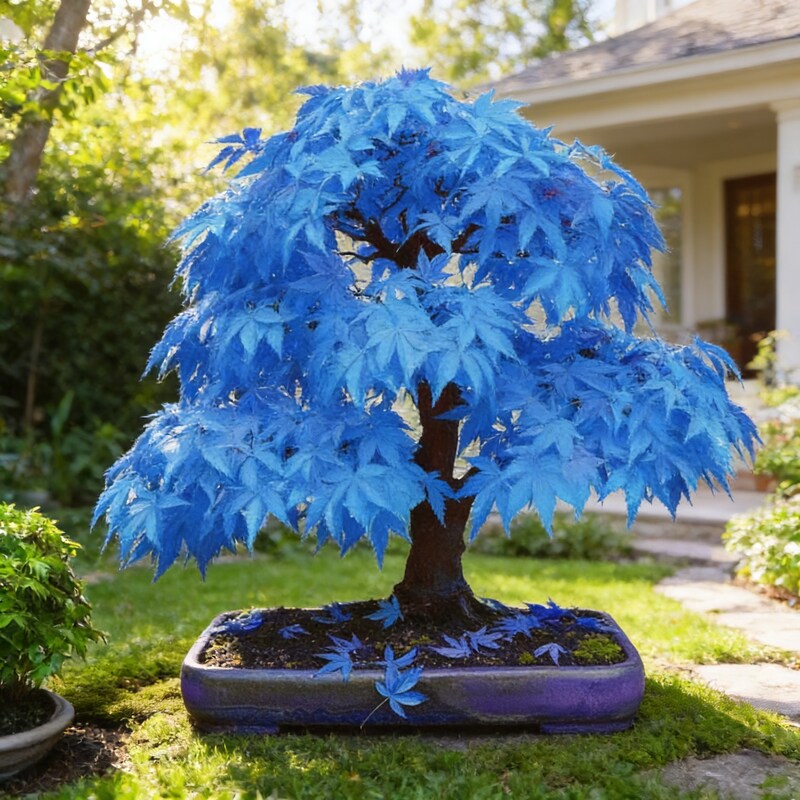

Life Cycle
Perennial

Plant Characteristics
Dwarf ornamental

Growth Habit
Compact upright

Bloom Season
Spring

Flavour Profile
Not edible

Suitable for
Outdoor

Planting Season
Spring

Fruit Size
Small samaras

Plant Height
3 to 6 ft

Light Requirement
Full sun

Water Needs
Moderate

Hardiness Zones
5 to 8

Container Garden
Yes

Plant Spacing
3 to 4 ft

Planting Depth
0.5 inch

Growing Conditions
Cool temperate
Frequently Asked Questions
Does a truly "blue" maple exist, or is this a color exaggeration?
Does a truly "blue" maple exist, or is this a color exaggeration?
No maple naturally has vivid blue foliage; "blue maple" typically refers to blue-green or silvery-toned leaf varieties, so expect a muted blue-green cast rather than true blue.
Since no scientific name is given, what maple is this likely referring to?
Since no scientific name is given, what maple is this likely referring to?
Without a species name, it's difficult to confirm exactly, but it likely refers to a small ornamental maple cultivar selected for unusual foliage tone and compact size.
Will this maple still show fall color change?
Will this maple still show fall color change?
Most maples, even blue-green-toned ones, still shift to red, orange, or yellow tones in autumn, so some seasonal color change is likely even with an unusual base leaf color.
Will seed-grown plants reliably keep the same blue coloring and dwarf size?
Will seed-grown plants reliably keep the same blue coloring and dwarf size?
Unusual color and dwarf traits in maples are often preserved through grafting; seed-grown plants can show more variability in both color intensity and final size.
Will this tree self-seed via its samaras?
Will this tree self-seed via its samaras?
Maples commonly self-seed via their winged samaras, so volunteer seedlings may appear nearby, though they may not match the parent's exact traits.
How do I know when this dwarf maple has outgrown its container?
How do I know when this dwarf maple has outgrown its container?
Roots becoming visibly crowded, circling the pot's edge, or emerging from drainage holes are signs it's time to consider a larger container or ground planting.