


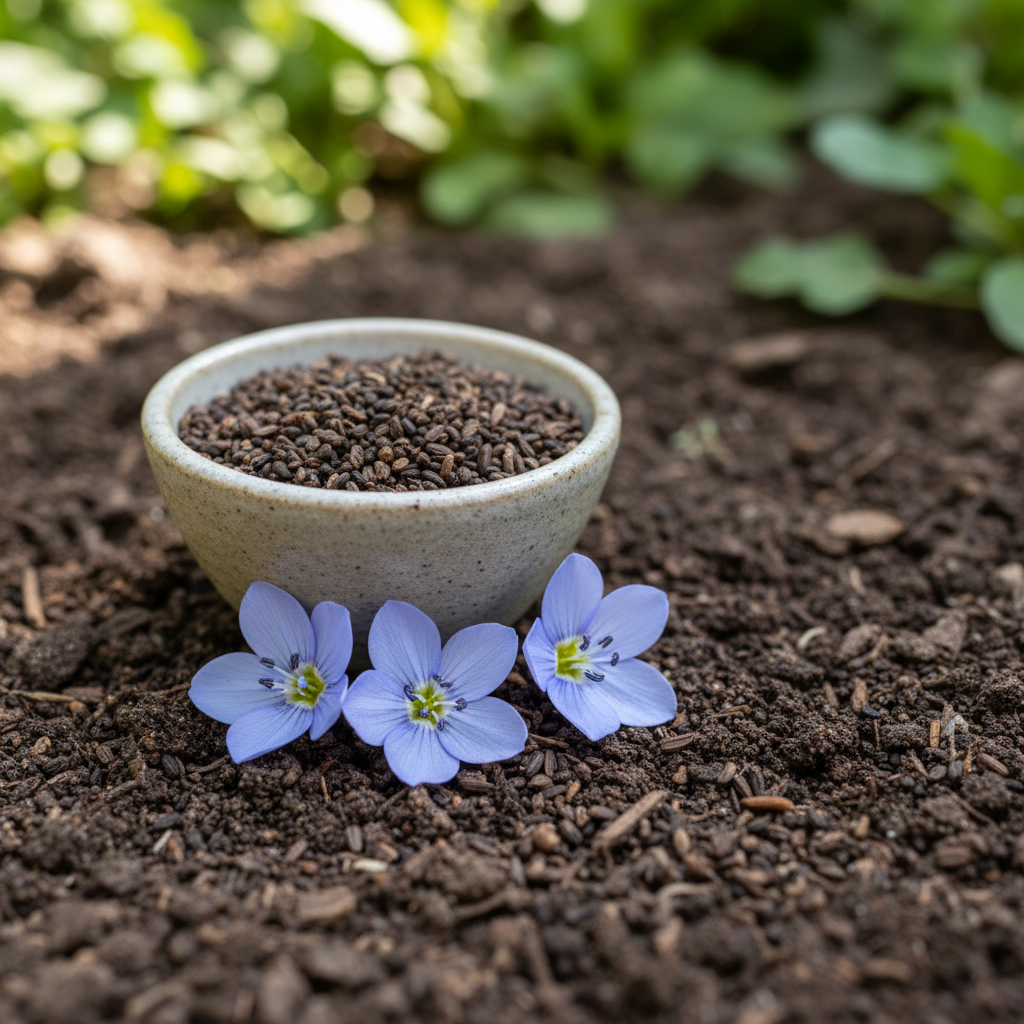

Life Cycle
Perennial

Plant Characteristics
Grass-like foliage

Growth Habit
Clump-forming

Bloom Season
Late Spring

Flavour Profile
Ornamental

Suitable for
Outdoor

Seed Type
Open-pollinated

Plant Type
Flowering plant

Planting Season
Spring

Fruit Size
N/A

Plant Height
12–18 inches

Light Requirement
Full Sun

Water Needs
Moderate

Hardiness Zones
4–9

Container Garden
Yes

Plant Spacing
6–8 in

Planting Depth
Shallow

Growing Conditions
Well-drained soil
Frequently Asked Questions
Can Blue-eyed Grass create a lawn-like appearance without being a true grass?
Can Blue-eyed Grass create a lawn-like appearance without being a true grass?
Yes. Although it has narrow grass-like leaves, it belongs to the iris family and is grown as an ornamental flowering perennial.
Do the blue flowers open only in bright sunlight?
Do the blue flowers open only in bright sunlight?
Yes. The star-shaped blooms typically open in sunny conditions and may close during cloudy weather or in the evening.
Can Sisyrinchium idahoense be planted beside ponds or rain gardens?
Can Sisyrinchium idahoense be planted beside ponds or rain gardens?
Yes. It grows well in consistently moist soils, making it suitable for pond margins, rain gardens, and meadow-style plantings.
Will Blue-eyed Grass form neat clumps over time?
Will Blue-eyed Grass form neat clumps over time?
Yes. Mature plants gradually develop tidy clumps, adding fine texture and seasonal color without becoming invasive.
Can Blue-eyed Grass be combined with native wildflowers?
Can Blue-eyed Grass be combined with native wildflowers?
Yes. Its compact habit blends well with native perennials and wildflowers in naturalistic and pollinator-friendly landscapes.
Do the seed capsules add interest after flowering?
Do the seed capsules add interest after flowering?
Yes. After blooming, the flowers develop small rounded seed capsules that provide subtle ornamental interest before releasing mature seeds.